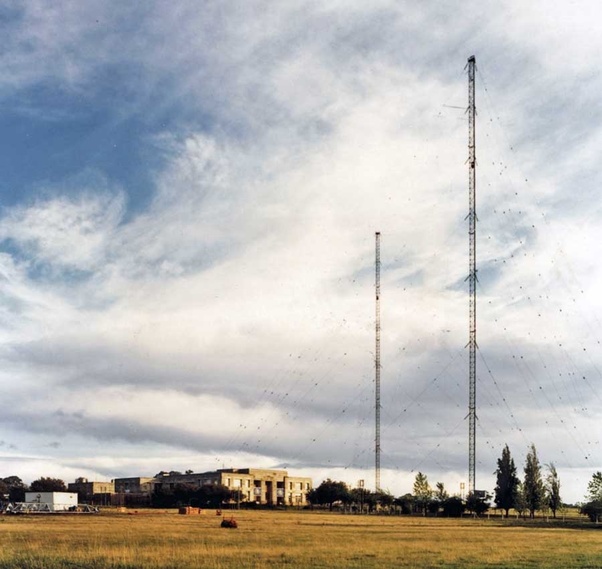
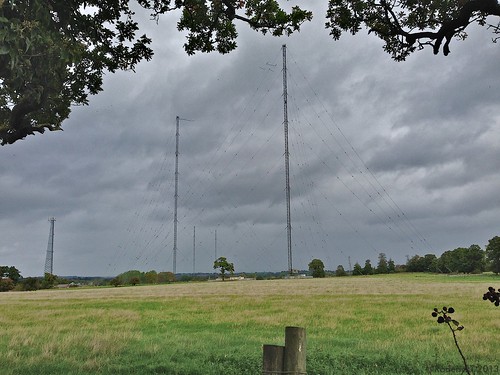
The ability of longwave transmissions to travel large distances is well known. But less well-publicised is the ability of the single longwave transmitter at Droitwich, Worcestershire, to broadcast signals across the European continent and beyond. At a time of international tension, it is becoming increasingly clear that this is one of the most important transmitters in the world.
Broadcasts from the 89-year-old transmitter began in 1934, intended to bring the voice of the BBC to listeners across the entirety of England and Wales. But it soon became clear that the signal was far from restricted to these shores. The Droitwich transmitter was used to carry signals onto the European Continent during the Second World War, and continues to provide BBC Radio 4 to much of northern Europe to this day.
When it was announced that the BBC plans to cease longwave transmissions soon after 1st April 2024, listeners from across the globe expressed their sadness and dismay. The Campaign to Keep Longwave, which set up a petition to preserve the platform in the summer of 2023, has since that time received tens of comments from far beyond the UK, many of whom will be bereft of access to BBC radio in its absence. Listeners from Germany, Belgium and Italy have all sent messages of support for the campaign. One listener in Scandanavia commented,
To me, BBC on longwave means news. Factual reporting. Around the clock. On a car radio receiver in central Sweden. Longwave is unbeatable when it comes to covering larger areas.
Perhaps the most surprising messages, though, came from Newfoundland and central Canada, where the longwave signal is much appreciated in suitable weather conditions.
Please keep BBC 198 Droitwich on longwave on the air. In wintertime during long cold nights when there is little atmospheric static I can hear this station all the way across the Atlantic Ocean from my home in Central Canada… In an emergency when the power is out and the cell towers are down, you will be glad you kept this backup alive.
Many listeners, both within the UK and abroad, have noted the importance of the transmitter given the uncertain political situation in Europe. Whilst the internet is relatively easy to block, and local media can be manipulated, hostile powers would find it very difficult to prevent reliable information from arriving via longwave on the BBC.
In fact, the BBC itself has acknowledged the importance of analogue radio in warzones. Shortly after the outbreak on war in Ukraine in 2022, the BBC resumed old-fashioned shortwave radio broadcasts in the region, as these are very difficult to block. Analogue transmissions have also proved vital to providing reliable information in Gaza, with medium-wave being used to carry BBC News Arabic into the region.
A UK-based listener commented,
A.M. Broadcasts are still valuable to many people across the country, the seas around the UK and ex pats in the EU. It’s short sighted to close such a valuable service, that in times of national emergency can even be received on equipment requiring no power at all. Longwave is probably the most reliable and dependable radio medium available. I’m actually surprised there arn’t more stations using it. I know the transmitter is elderly, but I think an upgrade is essential to our main nation’s broadcaster
A petition to retain BBC Radio 4 longwave has so far attracted over 2,000 signatures (as of January 2024), and efforts continue to preserve this internationally important piece of radio history – a continued source of reliable news for thousands of people.
Please sign the petition to help keep Droitwich longwave on the air.
 Keep Longwave
Leave a comment