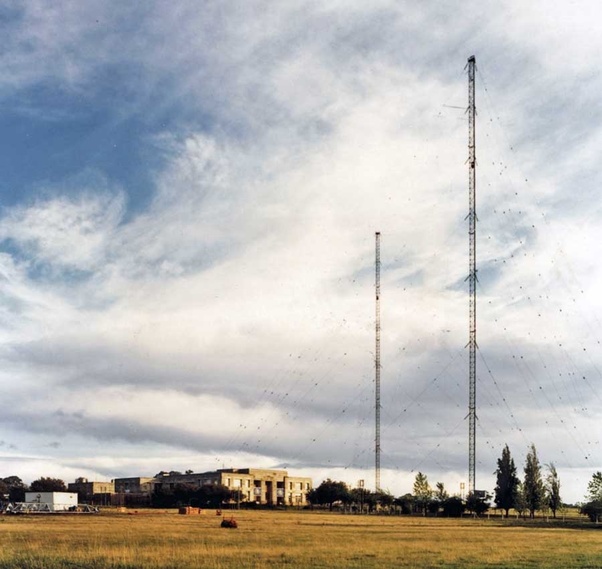

What has your boiler got to do with your radio? Quite a lot if you use Economy 7 Teleswitching. Introduced in the 1980s, this technology allows central heating systems to be switched on and off using a time signal received by radio. Naturally, with its near-complete reliable coverage of the entire country and zero time-delay in broadcasts, the 198 kHz signal of BBC Radio 4 Longwave was chosen to provide this signal. Radio listeners won’t notice, but alongside their favourite Radio 4 and World Service programmes, this time signal is still broadcast day in, day out on longwave. Today, it turns out that teleswitching is helping to keep longwave alive – at least for a few more months.
Whilst teleswitching has served millions of homes across four decades, the technology is being gradually replaced by electronic ‘smart meters’ that do not require an analogue radio signal to tell the time. The roll-out of these meters was expected to be complete by March 2024, which is why the BBC had planned to cease longwave transmissions from this date. The BBC receives funding from the energy companies to broadcast the teleswitching signal, which was expected to end from April 2024. Without this funding, the BBC has decided that longwave listenership is too low to justify the expense of maintaining and running the transmitter, and it is possible that without teleswitching longwave would have been shut down many years ago on this basis. However, delays in the smart meter roll-out, and technical problems with the meters themselves, mean that up to a million UK homes still depend upon the teleswitching signal as of early 2024.
For this reason, the BBC has agreed to continue broadcasting the signal until at least June 2025. This is great news for Radio 4 listeners in the UK and abroad, as it means the longwave transmissions are likely to continue until at least that date. When asked about this, the BBC stated that it was a ‘good assumption’ that Radio 4 would continue to be broadcast on longwave alongside the teleswitching signal, though it was unable to confirm that this would be the case.
After June 2025, however, the BBC still plans to shut down longwave, a little over 90 years since broadcasts began at the main Droitwich transmitter, on the assumption that longwave listenership is now negligible in the wake of digital radio and BBC Sounds. The BBC has failed to provide any concrete longwave listening figures, however, nor has it conducted surveys in remote and rural areas that generally depend upon longwave to verify that it is no longer being used. The Campaign to Keep Longwave is continuing to urge the BBC to reconsider this decision, and to keep longwave broadcasts providing an essential analogue service to thousands of listeners in the UK and beyond.
Whilst the longwave signal is currently transmitted using old-fashioned and expensive valves, there are alternative, more reliable and cheaper ways of continuing the longwave transmission which we are urging the BBC to explore.
The potential postponement of the longwave shut-down does not affect the demise of the BBC’s longwave-only programming, which is planned to end on 31st March 2024. After this date, BBC Radio 4 Longwave will be a simulcast of Radio 4 FM. ‘Yesterday in Parliament’ and ‘Daily Service’ will move to digital-only on Radio 4 Extra, ‘Test Match Special’ will be exclusively available on digital-only Radio 5 Extra, and the two longwave-only Shipping Forecasts at midday and 5.54 on weekdays will cease entirely. This is part of a wider shake-up of Radio 4 schedules that will see many programmes moved to new time-slots or cancelled altogether. Listeners are urged to contact the BBC with comments regarding these changes.
If you have not yet signed our petition, please do so now at https://www.change.org/p/keep-bbc-radio-4-longwave/
Please help keep longwave broadcasting for the next generation!


 Keep Longwave
Leave a comment