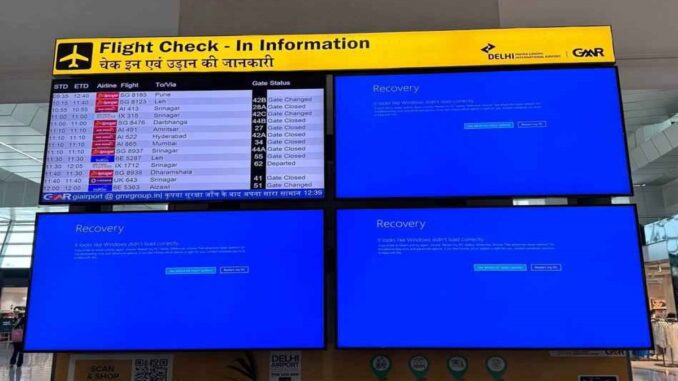
On Friday 19th July 2024 many computer systems around the world were affected by a faulty software update, which prevented them from starting correctly. Ironically, it was the very software designed to prevent hostile ‘cyber attacks’ that was at fault, which is why it was businesses and organisations that tended to be affected, not personal computers. Around 8 million machines were brought offline by the fault, causing significant disruption to airlines and some ticket vending machines. Thousands of travellers were left stranded at airports. More seriously still, GP appointments were thrown into chaos. By 20th July, the fault was rectified and systems returned to normal, but the after-effects were still being felt.
“If the internet goes down, society will simply grind to a halt.”
The IT outage shows how widespread the consequences can be from even a small fault on internet-connected computers. The whole thing was caused by just a single file, deleting which would fix the problem. A deliberate attack on computer systems can have much longer-lasting effects that are much harder to fix; we need only recall the ‘ransomware’ attack that affected NHS computers in 2018. Though keeping software up-to-date can help protect against such attacks, when it comes to the internet there is no fool-proof guarantee that services are protected from deliberate attack or unforeseen fault. It could be a deliberate act of cyber warfare, perhaps launched by Putin’s Russia; it could be a solar flare that brings down satellite and ground-based communication networks. It is worth remembering that the world wide web is only a little over 25 years old, and hasn’t been around for nearly long enough for us to witness the worst that can happen. The internet is much more fragile than is sometimes assumed.
None of this means that we shouldn’t use the internet, or take advantage of the benefits that it can bring. But it does mean that it would be very unwise to ‘put all our eggs in one basket’, as the saying goes, and come to rely on the internet for everything. If we do that, and the internet goes down, society will simply grind to a halt.
“During an internet or power outage, it is analogue radio that is most likely to remain steadfast”
This applies in the arena of broadcasting as much as anywhere else, and indeed broadcasting could be said to be more important than many other sectors, as it is through broadcast media that we obtain information during a crisis. Reliable media can provide much-needed advice and information, and prevent widespread panic, during a crisis. This is why the Campaign to Keep Longwave believes that it is imperative that we do not switch all broadcasting to digital and internet-based channels. During an internet or power outage, it is analogue radio that is most likely to remain steadfast – and longwave, with its ability to broadcast to almost the entire nation and beyond from just three transmitters, and to be received easily on low-power battery radios, is the most resilient mode of broadcasting of them all.
It is noticeable that broadcasting wasn’t unaffected by Friday’s outage. Both Sky News and the CBBC channel were brought down, as they relied on computers that had received the faulty update. It is easy to image a more widespread internet shutdown, or a more targeted cyber attack, bringing down the BBC iplayer and BBC Sounds remotely. The computers that digitise content for broadcast on digital television and radio are also subject to an internet-related attack. In that case, in the absence of analogue radio there would be no means of the public receiving much-needed information.
There are many other reasons for retaining longwave radio – its ability to reach rural areas and its far greater energy-efficiency than internet streaming are just two of them. But the most critical reason of all is to prevent an information black-out in the event of national disaster. We therefore call upon the BBC to revoke its ill-considered cost-cutting plan to abolish longwave broadcasts, and to keep Radio 4 Longwave – for all our sakes.
Please sign the petition now at www.keeplongwave.co.uk

 Keep Longwave
Leave a comment