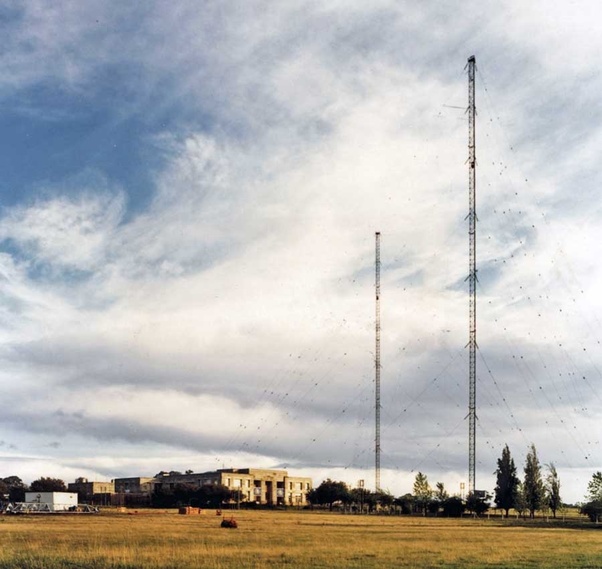
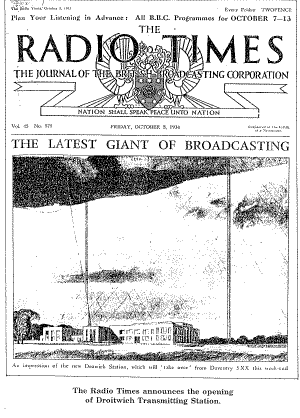
Today, 6th September, marks the 90th anniversary of longwave transmissions beginning at Droitwich at 3:45pm to great acclaim. The situation in September 1934 was very different to how it is today. In terms of communications, radio was king – the only way of sending information instantaneously over a large area. Longwave, with its ability to travel vast distances and diffract around hills, was judged by far the best means of broadcasting to the nation efficiently, with just a single transmitter needed to cover almost all of England and Wales. That’s why Droitwich, with its central location in the heart of England, was chosen to host the new BBC masts.
At the time, the technology was cutting edge. At 150 kilowatts of power, Droitwich’s signal was so clear and loud that older sets weren’t able to tune to anything else. The transmitter rivalled any in the rest of the world, and indeed could be heard far beyond the shores of the UK, providing much-needed information to boats on the high seas and, later, to a war-ravaged European continent. Over ninety years of sterling service, the same masts have radiated the best of British radio to the world day in, day out, albeit with refurbished, more efficient transmitting equipment installed in the 1970s and 80s. The Home Service, Light Programme, Radio 2 and Radio 4 have all occupied the airwaves on longwave from this station, the latter being broadcast since 1978 on 198 kHz.
However, despite all of today’s technological advancements and everything that has changed since 1934, longwave radio remains the most efficient way of broadcasting information to the nation. Most listeners don’t realise that FM and DAB radio both require a dense network of thousands of transmitters across the country to provide the same coverage as Droitwich alone provides. Internet radio, including ‘smart speakers’ and services such as BBC Sounds, isn’t really ‘broadcasting’ at all – it is ‘narrowcasting’, because it requires each individual computer to have its own connection with the internet server providing content. Taking into account the electricity needed to run such servers, this requires vastly more energy per listener than longwave. In an age of climate change, longwave therefore still represents the best, most cost- and energy-efficient, option when it comes to broadcasting of any sort. It also remains a vital back-up option for when online and digital services are disrupted, for example during a conflict or internet outage.
In 1984, the BBC celebrated 50 years of the Droitwich transmitter with a banquet at the site itself, attended by tens of high-ranking employees and the local mayor. In 2024, the BBC has ceased even to mention longwave on its on-air announcements and acknowledgement of the date is restricted to a short article on the History of the BBC website. Let’s hope that the corporation sees sense and comes once more to appreciate properly the precious asset that is Radio 4 Longwave.
9 Milestones for 90 years
Read on for our pick of 9 key events that have marked the 9 decades of Droitwich’s reliable service so far.
1
Launch of Radio 1
1967: BBC Radio was radically transformed by the re-launching of the existing national stations as Radios 2, 3 and 4, plus the launch of brand new pop station Radio 1, soon a hit with younger listeners. Droitwich transmitted Radio 1 on 1215 kHz mediumwave for the West Midlands, alongside Radio 2 nationally on LW.
2
Lifeline in WW2

On 1st September 1939 all British transmitting stations were temporarily shut down and reconfigured according to an emergency protocol. A single Home Service was created on mediumwave from the pre-war Regional and National programmes. From 1941, Longwave was switched over to the European Service, a new channel providing a vital source of reliable information across the whole of western Europe, which the powerful 400 kilowatt transmitter was uniquely capable of reaching. Droitwich was also used at times to jam long-distance radio signals from German Fighter Command, thereby playing an important role in the allies winning the war.
3
’33: Construction begins
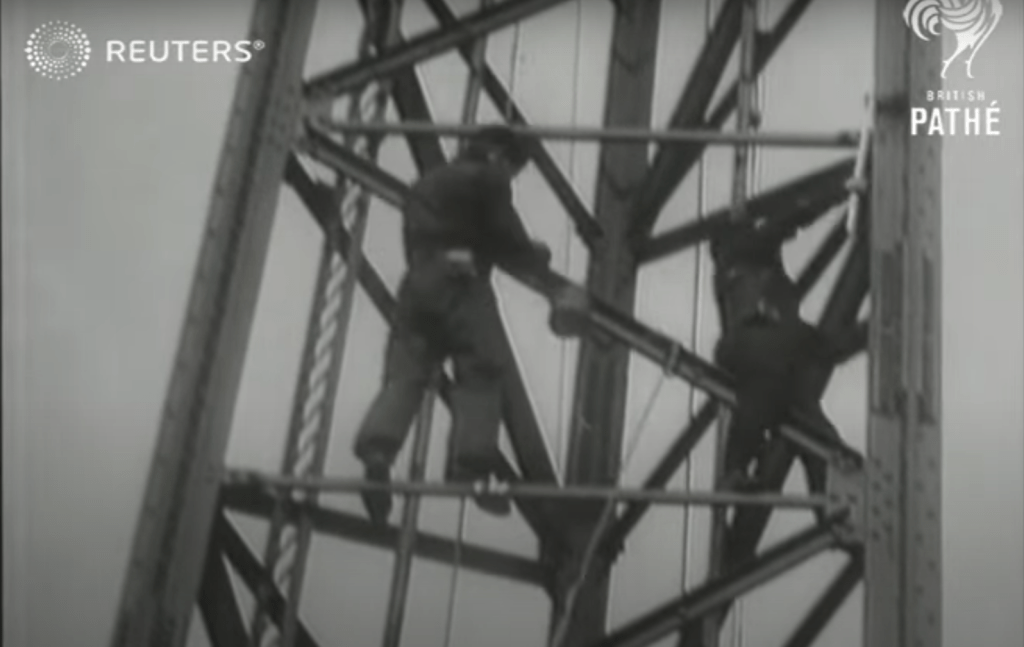

Work began in April 1933 with the laying of the approach road to the transmission site in Wychbold, Droitwich. Meanwhile work was beginning on the actual transmitter equipment at the Marconi Company in London. No structure this tall had ever been made before in England and there was a brief strike by the builders in October, who argued that they weren’t being paid enough for such a feat. This being resolved, the masts were completed, reaching 213 metres high Construction ended in summer 1934.
4
Radio 4 moves to LW

Prior to 1978, it was Radio 2 (originally the Light Programme) that occupied the 200 kHz longwave slot. This was because Radio 4 (the Home Service) carried regional programmes more suited to shorter-distance mediumwave. 1978 saw a considerable reconfiguration of the BBC’s frequencies, with Radio 4 moving to the national longwave slot, slightly adjusted to 198 kHz, that it has held ever since and Radio 2 moving to MW – both broadcast from Droitwich.
5
Launch of Radio 5
As FM became more popular, the BBC decided to move all its music stations (Radios 1, 2 and 3) to FM-only, not broadcast from Droitwich, in the 1990s. This left Radio 2’s old mediumwave slots vacant for a new speech station for news, sport and educational programming – Radio 5. The original format was short-lived, replaced by rolling news and sport on Radio 5 Live from 1994. Radio 5 Live is still broadcast on 693 kHz MW from Droitwich today.
6
Hitting 6 with TMS

Strange as it may seem to us today, Test Match Special was originally broadcast on Radio 3 (originally the Third Programme) Mediumwave, one of the transmission sites for which was Droitwich on 1053 kHz. Radio 3 having moved to FM, TMS was moved to Radio 4 Longwave in 1994 and has long been associated with the channel by cricket fans. In 2023, the programme left analogue radio and is now carried by a digital-only sister station of Radio 5 Live, ‘Radio 5 Sports Extra’.
7
Economy 7
Economy 7 was a high-tech energy saving technique when introduced in October 1978. Under it, electric storage heaters are programmed to switch on during the 7 hours when electricity demand is lowest overnight. This relies on an accurate time signal, and longwave radio was chosen to provide it nationwide. For nearly 50 years, households across the UK have relied on Droitwich to switch their heating on and off at the right times, and some still do today. It’s also how most electricity meters could tell whether electricity was being used on- or off-peak, prior to the roll-out of ‘smart meters’.
8
1980s Celebration
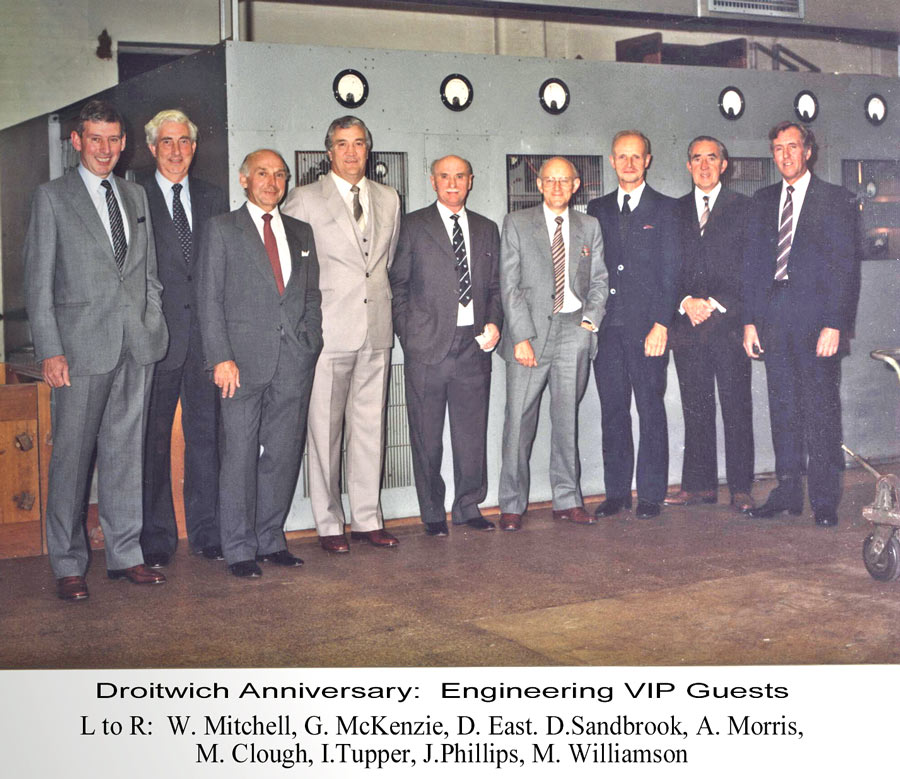
Given the huge importance of Droitwich to the functioning of the nation over its first 50 years, it is not surprising that a huge party was held to celebrate the 50th anniversary of the transmitter in September 1984. At this time, Droitwich was in its prime. Several people still worked at the station maintaining the machinery, and the party was held in the transmitter hall itself in the space saved by recently installing new, more efficient equipment. A week-long exhibition of the history of the site was staged at the same time.
9
90 years of Droitwich LW


Sadly, the latest milestone in Droitwich’s history may not be one to celebrate for long. In March 2024, separate longwave programming on Radio 4 was ended, and the BBC announced its intention to scrap LW broadcasts altogether. 90 years after its construction, however, thousands of people still listen to and love our stalwart friend, and have signed a petition for it to be retained. With war potentially looming and the internet not as infallible as is sometimes assumed, Droitwich remains as important as ever as a piece of national infrastructure. On Droitwich’s 90th anniversary, please sign the petition to keep the waves radiating for generations to come. Happy 90th birthday, Droitwich – may it not be your last.
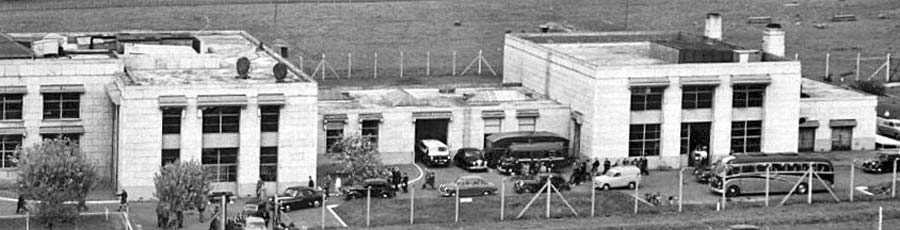
Find out More
A wonderful celebration of 90 years of the Droitwich transmitter, complete with an orchestra playing the first music broadcast, took place on 9th April 2024 in Bromsgrove. A video is available here. Please note that this event was not related to the Campaign to Keep Longwave.
You can learn more about the history of the transmitter on our longwave heritage page.
John Philips, for a long time an engineer at Droitwich, produced an excellent history of the site which is available online here.

 Keep Longwave
Leave a comment