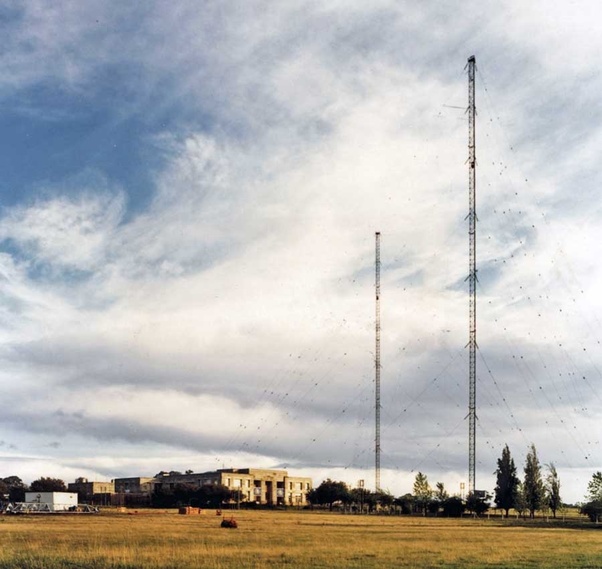

The BBC began broadcasts using longwave signals in 1925, just three years after the company’s first radio broadcasts began. To begin with, those transmissions were made from Daventry in Northamptonshire, which became somewhat of a broadcasting hub. However, the power output of this transmitter there was low, and the BBC soon began searching for a dedicated site for longwave broadcasts, which would bring the National Programme to the whole of the country. Ultimately, a site at Wychbold near Droitwich in Worcestershire was chosen, largely because of its rural location towards the centre of the British Isles, which would allow the signal to reach nearly the entirety of the UK, with supplementary transmitters serving parts of Scotland. Construction of the masts and transmitter hall was begun in 1933 and broadcasts began on September 6th 1934.
It soon became evident that the new transmitter was a success. The quality of reception met or exceeded expectations and there was even concern that listeners using older sets would be able to tune to nothing else, the signal from Droitwich being so strong. The National programme fully switched from Daventry to Droitwich on 7th October 1934, broadcasting between 10.15am and midnight every day. The first programme every day was Daily Service, and transmissions ceased with dance music at midnight.
Video: Constructing the Droitwich Transmitter
Alongside national longwave broadcasts with a power output of 150 kilowatts, rivalling the most powerful European transmitters of the time, Droitwich also broadcast the BBC Midland Regional Programme at a lower power on mediumwave. This began on 17th February 1935 at 4.30pm. The longwave broadcasts continue to this day, with the 200kHz longwave National Programme having been renamed BBC Radio 4, and the Regional Programme having been replaced by BBC Radio 5 Live on 693kHz mediumwave.
During those early years, Droitwich Transmitting Station was somewhat of a popular attraction. The 1930s equipment required a complex of buildings to operate, and a dedicated team of technicians who had quarters on site and a canteen. For the first four years, the transmitter had its own diesel power supply, though after that time it was decided to connect it to the national grid, using the diesel generators as a back-up if the power failed. Large transmitting valves were used, which required a cooling pond to operate, containing many kinds of fish whom visitors liked to feed. The opening itself was attended by around 150 press and dignitaries, conveyed on a midland red bus from Droitwich railway station.

Wartime hero
The Droitwich transmitter proved to be a vital asset during the Second World War. At first, longwave transmissions were ceased, with all the regional mediumwave transmitters around the country being co-opted to broadcast a single Home Service, including the midland regional from Droitwich. However, broadcasts on longwave resumed on 16th November 1941, carrying the European Service. Longwave’s unique ability to travel large distances meant that the signal could penetrate into much of occupied Europe, broadcast from a location far removed from the danger of enemy attack. The signal was also used towards the end of the war to jam transmissions that the enemy was likely to use to issue instructions to Luftwaffe pilots approaching Britain.
When peace returned, the transmitter was returned to its pre-war duties, albeit with slightly rebranded output. The Midland Regional Programme became the Regional Home Service on mediumwave, joined on a different mediumwave frequency by an entirely new service called The Third Programme, whilst the 200kHz longwave signal now carried the new national BBC Light Programme. In 1950, the power was increased from 150 to 400 kilowatts, allowing the longwave signal to travel even further than previously. In 1957, an Open Day was held, attended by over 6000 people and causing a traffic jam on the A38 locally. Further open days were held in 1961 and 1963.

Change and Continuity
Major works were carried out at Droitwich in 1978 to replace ageing equipment and enable the transmitting station to carry all four national networks, now rebranded as Radios 1, 2, 3 and 4. This required some changes to the masts, as well as the transmitter hardware that used them. By now, transmitters took up much less space than had been the case in the 1930s, leaving much of the space at Droitwich now redundant. The number of technicians required was also reduced. It was at this point that Radio 2 – the former Light Programme – left longwave and switched to mediumwave, with Radio 4 taking the longwave slot on 200 kHz (later changed to 198 kHz) where it remains to this day. With Radio 4 no longer available on mediumwave, the two longwave transmitters in Scotland – at Westerglen and Burghead – were set up using the same frequency.
The present configuration of the transmitters at Droitwich remains largely as it was from the early 1980s, when two new masts were installed for mediumwave broadcasting, in those days for Radio 1 and Radio 3. This is why there are now four prominent masts visible from the M5 motorway approaching Droitwich. The two taller masts are the original ones, and support the very large longwave aerial broadcasting Radio 4 on 198 kHz. One of these masts is also used to radiate Radio 5 on 693 kHz mediumwave. One of the two smaller masts now carries Talksport on 1053 kHz, whilst the other used to carry a signal on 1215 kHz, made redundant in 2023 by the withdrawal of Absolute Radio from mediumwave. These two frequencies were formerly used for Radio 1 and Radio 3 respectively, whilst 693 formerly carried Radio 2 until these three radio stations moved to FM-only in the 1990s. But the key, national signal on longwave remains BBC Radio 4, still broadcast from the same masts at Droitwich as the National Programme in 1934.
Celebrating a Stalwart
On 6th September 1984, the fiftieth anniversary of longwave transmissions beginning at Droitwich, a celebration banquet was held at the site for 110 special guests. The old ‘lower transmission hall’, was specially decorated for the occasion, the Radio 4 transmission equipment now taking up just a small fraction of the space that had originally been required for high-power broadcasts. A special exhibition was also set up in the entrance hall to celebrate the occasion.
Alas, this was somewhat of a farewell for the broadcasting station’s public face. The installation of new, much more efficient generators in the late-1980s, which could start automatically in just a few seconds in the event of a power failure, meant that there was no longer any need to have a technician present on-site at all. The site is now visited sporadically by engineers from its current owner, Arqiva, and many of the fine 1930s buildings – including the entrance hall – have been demolished. Others sit largely empty, housing the modicum of equipment still required to broadcast longwave and mediumwave signals today.
We now approach the 90th anniversary of transmissions at Droitwich in September 2024. Far from celebrating longwave’s long and illustrious history, however, the BBC has announced plans to shut the service down. As well as being a tragic loss of this historic service, such a decision would also leave parts of the UK starved of non-digital means of communication, which could prove very unfortunate in the event of a national crisis. You can read more about why this is the case on our national security page.
Please sign our petition to keep BBC Radio 4 on longwave, and help preserve a radio treasure for generations to come.
 Keep Longwave