
It requires just one sixth of the energy to broadcast Radio 4 to the entirety of the UK on longwave (LW) as compared to FM, according to a report for the Campaign to Keep Longwave to be released later this month. These figures cast further doubt on the BBC’s claim that switching off longwave would save energy because ‘longwave broadcasts are energy-intensive’, and strengthen the case for keeping Radio 4 Longwave in operation.
The report looked at Ofcom data for all the BBC Radio 4 FM transmitters in the country – 214 in total – to determine the total power output on FM. Although most FM transmitters radiated a relatively small amount of power, there are so many of them that the combined output comes to 3.41 Mega-Watts – the equivalent to boiling over 1000 kettles simultaneously. This power output is required to provide at least a weak FM signal to an estimated 98% of the UK population.
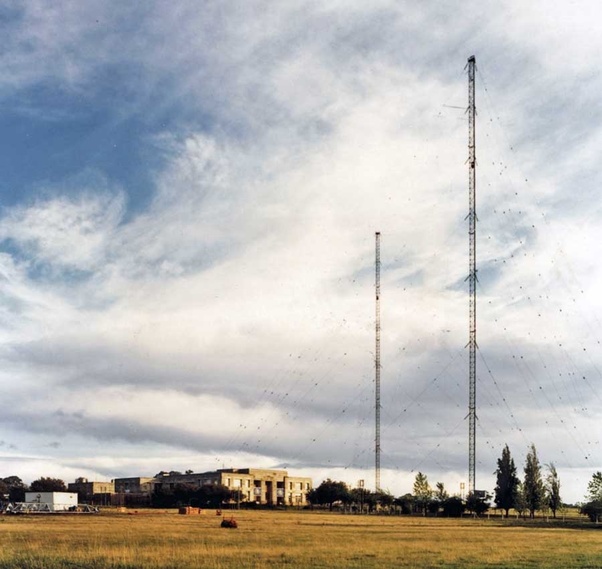
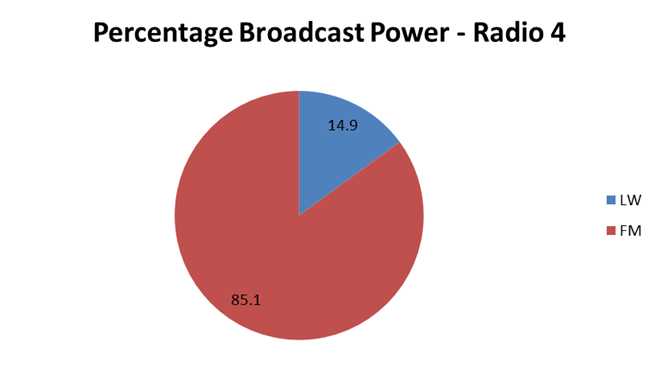
The combined power output of the three longwave transmitters at Droitwich, Burghead and Westeglen, meanwhile, is just 0.6 Mega-Watts, which is around 1/6 of the FM output. This is to provide clear, reliable coverage to essentially 100% of the UK population. Figure 1 shows the percentage of the total broadcast power output of BBC Radio 4 attributable to each of FM and LW. It shows that LW is much more efficient, requiring just 15% of the total power to provide more coverage than FM, which accounts for the remaining 85%.
BBC Radio 4 is just one of 5 national networks that the BBC broadcasts on analogue radio. The report also looked at the percentage of the total power output of BBC analogue radio that longwave accounts for. This meant adding up the power requirements of all the FM transmitters for BBC Radios 1-4, and the MW transmitters for Radio 5. Figure 2 shows the results.
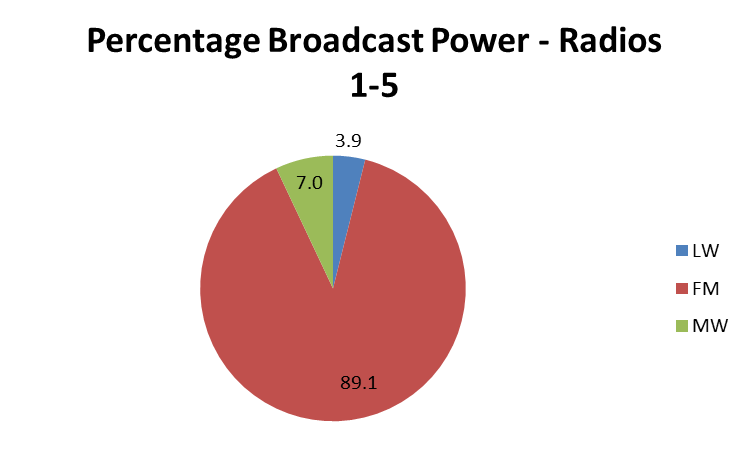
The data shows that longwave accounts for just 4% of the BBC’s analogue radio power output across all its national networks. That means that shutting down longwave would have a very small effect on the BBC’s total power requirements for analogue radio broadcasts.
The report contains the caveat that it only looks at power output. If longwave broadcasting infrastructure is less efficient than newer FM transmitters, this could raise the amount of energy input required to broadcast on longwave, relative to the data shown here. However, it would be possible for the BBC to switch over to using newer, more reliable longwave transmitters at its existing broadcast sites to mitigate this effect.
In any case, the figures above show that FM radio is far less efficient for achieving nationwide coverage than LW, regardless of the efficiency of the current longwave transmitters. FM is well-suited to local broadcasting because its signals do not travel far. It is not well-suited for national broadcasting, where LW – which travels much further – is much more efficient.
It should be remembered that longwave signals reach the entire country loud and clear, where in many rural locations the FM signal is either non-existent, or too weak to be of any use. There are many places where FM and DAB are simply not available, whereas longwave is always available, right across the UK and beyond. The small percentage of the population with no access to FM and DAB should not be forgotten or ignored – 98% of the population being able to receive FM means that 2%, or around 1.5 million people, cannot. Many of these people continue to depend upon longwave.
If the BBC wanted to save energy, it would therefore be much more effective to switch off one of its four national FM networks, rather than longwave or medium wave, and use FM for local and regional broadcasts where it is most suitable.
The BBC has suggested that it wants to switch off longwave at the end of June 2025. The Campaign to Keep Longwave believes that this would be a national tragedy. Our full report, which sets out all the arguments for keeping Radio 4 Longwave, will be published later this month.
Please help by signing our petition to keep longwave.


 Keep Longwave
Leave a reply to Analogue Radio Resurgence amidst Power Cut Fears – Keep Longwave Cancel reply