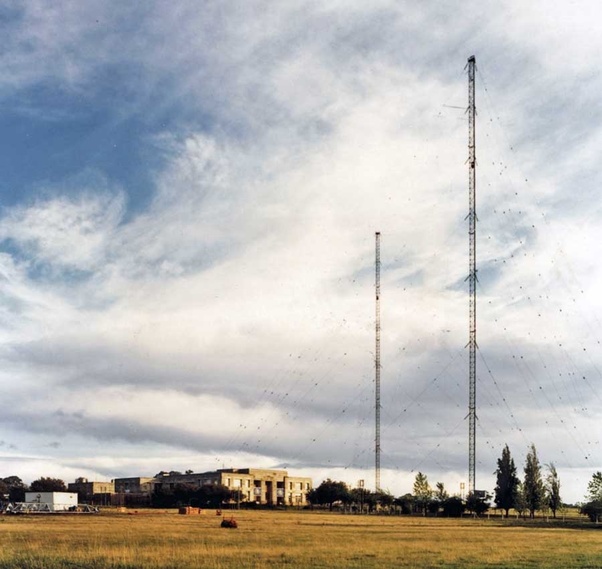
The UK’s media regulator has published an article on its website encouraging sports fans to use AM (which includes longwave) and FM radio. In a piece timed to coincide with the World Cup, Ofcom urges spectators to ‘keep up with play and avoid the delay’ by avoiding watching or listening to matches via internet streaming services which have a significant time delay. The message comes nearly three years since the BBC broadcast its final sports coverage on longwave, and possibly just days away from the axe falling on its flagship AM platform.
Time delay has long been identified as a problem with digital broadcast media. Whilst AM and FM radio is ‘near instantaneous’, according to the Ofcom article, audio streamed over the internet encounters a 20 to 50 second delay due to the time taken for signals to be digitised, packaged, uploaded to servers and downloaded to an internet-connected device. Streamed video fares even worse, with delays of up to 100 seconds. This means that a viewer watching a sports match via the internet might not know the outcome until nearly 2 minutes after a listener hearing the same match on AM or FM radio.
The phenomenon will not have gone unnoticed by fans attempting to listen to sports commentary whilst attending a match themselves. Where it would have been possible, for example, to tune into Test Match Special on Radio 4 Longwave and hear commentary at the same time as events were happening on the ground, attempting to do the same thing via digital radio incurs a lag of several seconds. Internet radio services such as BBC Sounds are even worse for this effect – as can easily be demonstrated by streaming Radio 4 at the same time as listening to it on your FM or LW radio.
This matters not only because of sports fans wanting to know the outcome of an event as soon as it happens, rather than minutes later. AM and FM radio have for decades provided a reliable time signal across the United Kingdom – you know that when the sixth ‘pip’ sounds on Radio 4, time time is exactly on the hour. That can be helpful for the general public needing to know exactly what time it is, but also for scientists and engineers whose experiments and hardware depend upon very accurate timing – the importance of which was highlighted recently by the creation of the National Positioning, Navigation and Timing Office. Radio 4 Longwave has long provided a nationwide reference time that facilitates these uses. That is why it is used to switch heating on and off via the Radio Tele-Switch (RTS) service still relied upon by over 100,000 households.
The withdrawal of analogue radio services removes access to this signal, meaning that news and information can no longer be transmitted instantaneously and a time reference is lost. The BBC and Ofcom have not explained what they expect to happen to the remaining RTS users if Radio 4 Longwave is taken off-air on Saturday 27th June, let alone considered how other applications using the time signal will have to adapt. Under the terms of Ofcom’s frequency allocation table, it is illegal for a time signal to be broadcast on 198 kHz longwave without an audible broadcast signal being transmitted at the same time.
The Campaign to Keep Longwave continues to oppose the withdrawal of BBC longwave broadcasts, and, if they do cease as threatened on 27th June, will support the reinstatement of broadcasts on this frequency. We also support the continued use of other AM broadcasts, notably medium-wave, which become all the more vital for instantaneous and wide-ranging communication in the absence of longwave. The Department for Culture, Media and Sport has recently launched a review of the future of British radio. In light of the unique features of AM radio, not least among them its zero time delay, it must surely continue to have a place within the broadcast spectrum for decades to come.


Leave a Reply