Importance of Longwave Mentioned in Parliament

Published by

on

The unique capacity of longwave radio to provide reliable news and information during a time of crisis was mentioned in Parliament last week. However, even as the Droitwich transmitting station celebrates its 92nd birthday, the future of longwave – and of radio in general – remains uncertain.

Longwave had its mention during a debate on the government’s Media Green Paper on Tuesday 8th September, when Droitwich and Evesham MP Nigel Huddleston commented on the platform’s recent closure, and expressed his appreciation for the useful service that longwave could still provide. Following the closure of longwave transmissions in June 2026, ‘I was disappointed that Historic England could not list the station,’ Mr Huddleston said. ‘Furthermore, there are security aspects to retaining long-wave capacity. It is very difficult to block analogue radio signals… and longwave transmissions have shown their usefulness in times of crisis. In a future wartime scenario, the UK might be thankful to have retained the infrastructure required to broadcast to the nation and beyond over distances of hundreds of miles.’

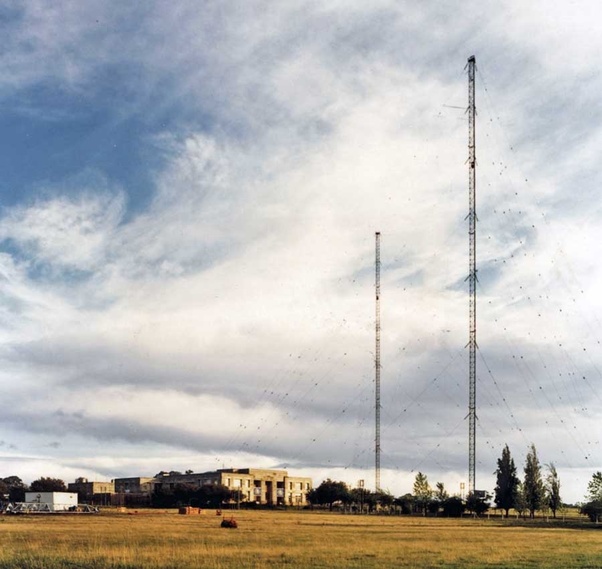
Unfortunately the BBC did not share Mr Huddleston’s appreciation for long-wave radio, ending their longwave broadcasts after over 100 years on 27th June. The transmitting infrastructure, including the two iconic masts, remain in place at Wychbold near Droitwich, Worcestershire, at a transmitting station that continues to broadcast BBC Radio 5 on 693 kHz and TalkSport on 1053 kHz Medium-wave. How long these broadcasts will continue, and what will happen to the longwave masts if they cease, remains unclear. At present, Droitwich is the only station in the world capable of transmitting radio signals across almost an entire continent – a capacity that is sadly being wasted.

The Campaign to Keep AM Alive continues to support the re-instatement of longwave broadcasts, if not by the BBC then by a commerical alternative. One such commercial option was put to radio regulator Ofcom earlier this year, but has not yet had approval to go ahead. Ofcom stated that it would consider new licence proposals ‘in the autumn’, but also stated to us, ‘In light of the diminishing audiences for AM and the trend we have observed of existing national AM licences being handed back to us, we propose that making further national AM licences available should not be a priority.‘ Longwave might be considered an exception to this, given that it is not just any other AM station.

In the absence of longwave, we would like to see the retention of medium-wave broadcasts of some sort to provide coverage to all parts of the country. AM radio alone can provide news and vital information across long distances, which may be essential during power cuts that knock out local transmitters. It is also cheaply and easily available to all.

Overall, radio had little mention in the government Green Paper that was debated last week, as this focussed mostly on television and the proposal to switch off Freeview in 2034 in favour of internet-based platforms. Whilst not welcoming this proposal, the Campaign to Keep AM Alive holds that radio is an even more vital lifeline, uniquely accessible without internet or local power supplies, and that any switch-off of AM radio in particular would be potentially disastrous. AM listenership may be less than it was decades ago, but this does not make it any less of a vital lifetime in times of crisis.

The importance of AM seems to have been recognised in the United States, where a bill is going through congress this week to have AM radio mandatory in cars for the purposes of receiving signals in an emergency. In the UK, a government Radio Review was announced in February, but how to make contributions towards this review, or what its results will be, is unclear. We would like to see government and the BBC commit to retaining at least a basic level of AM broadcasts indefinitely, for the sake of national security.

A new petition was launched this summer to keep medium-wave in the UK. Please help us to keep AM alive by signing and sharing it if you can.

Sign our petition to Keep Mediumwave


Addendum: 17th September 2026 The US House of Representatives has now passed the act requiring all vehicles to have AM radio capability. If passed by the Senate and signed into law, this would apply to all vehicles manufactured in or imported to the USA.

9 responses to “Importance of Longwave Mentioned in Parliament”

  1. Stephen Avatar
    Stephen

    The AM signal on 198 kHz was the only way I could access BBC radio out of UK in Europe.

    Like

  2. Martin Avatar
    Martin

    There’s many rural areas of Scotland where (unless you’ve got a satellite dish) only AM radio can be received.

    FM and DAB are a waste of time in the Highlands, particularly when travelling.

    Like

  3. Richard coates Avatar
    Richard coates

    I miss radio 4 198kHz long wave enormously. Here in the Isle of Man the FM signal is pretty poor…and ultra sensitive to movement or location. Massive pity …let’s keep at them. I’ve written to the BBC quite a number of times and will do so again now after this mention in Parliament.

    Like

  4. Paul Gregory Avatar
    Paul Gregory

    With the world as it is, and in a war the certainty of cyber attacks destroying internet coverage, it is lunacy not to have backup communication. That is long and medium wave transmissions.

    The policy makers, BBC and HMG have not answered the questions put to them, notably that the cost of retention is low, the bandwidths minuscule compared to digital and the impossibility of public communication in internet failure.

    Most of us have been in a retail shop where at some times the internet coverage has failed, and transactions are cash only.

    Long and medium waves are the cash equivalent of physical money. What on earth is suggested as a solution if those radio transmissions are not there?

    Like

  5. Paul Hollow Avatar
    Paul Hollow

    AM radio can cover longer distances than FM or Digital so you need fewer transmitters. For example Radio Caroline on 648kHz covers East Anglia and the South East using only 4kW and is powered largely by an array of solar panels so reducing the electricity bill. Other stations could use solar power as well to reduce their running costs instead of just shutting down their transmitters regardless. I realise that AM’s sound quality is not as good as FM or DAB but in an emergency tbat would hardly matter, I think its a big mistake to shut down the AM transmitters.

    Paul Hollow

    East Grinstead

    West Sussex

    Like

  6. Normin Avatar
    Normin

    Miss radio 4 198kHz long wave very much. With Droitwich being the only station in the world capable of transmitting LW radio signals across almost an ENTIRE CONTINENT and being immune to AI, surely it is obvious to retain it.

    Like

  7. David Hine (G4DIG) Avatar

    No commercial enterprize or the future “commercial” BBC would ever consider Long or Medium wave broadcasting, as there would be no profit or traditional broadcsting listeners there to make it economically viable. However, the other option is to allow these disused AM frequencies to become “citizen’s hobby bands”. Hobbyists would not be there for any financial prifit, only there for the hobby / interest aspect. A practical and workable idea would be to allow Radio Amateurs (Hams) free access. It’s not difficult to secure an Amateur Radio licence, and that would ensure adequate technical competancy and accountability of the hobby users and ensure non-interference to other sevices still using the radio spectrum. This would automatically protect the spectrum and provide technical know how of traditional non infrastructure dependent radio communication, VITAL in severe long lasting National emergencies. That’s how I see the future and vital use of the disused AM freqencies as a training ground in basic “point to point” stand alone voluntary communications. Best regards, David Hine (G4DIG)

    Like

  8. M R Beckwith Avatar
    M R Beckwith

    we now live in a world where there’s talk of AI and internet melt down surely a low cost medium with proven reliability has a place even if its just as a back up..

    whatever AI can do it can’t switch off long wave radio reaching people at home and abroad…only humans can do that.

    Like

  9. jovial41a5d83dc2 Avatar
    jovial41a5d83dc2

    I’m currently on holiday near the coast and the only station I can pick up (albeit extremely fainty) on FM is a French-station! Whereas on MW; multiple stations are coming across strongly; including BBC Radio Wales, BBC Radio Scotland, BBC R5, Talksport, a channel playing 80s pop, amongst several others.

    Even Radio Caroline can be faintly heard and I’m at the other side of the country!

    SquiddyGaming 🦑

    Twitter: http://twitter.com/Squidygame

    Website: http://151.244.232.25/

    Like

Leave a comment